


An important Italian university involved us to design and facilitate a co-design journey together with 150 professors. Three workshop days to explore the opportunities offered by artificial intelligence in university teaching and translate them into concrete, shareable practices.

How can we open a space for dialogue among professors on the use of AI in teaching, where they can share difficulties and experiences and imagine practices capable of transforming the academic context?
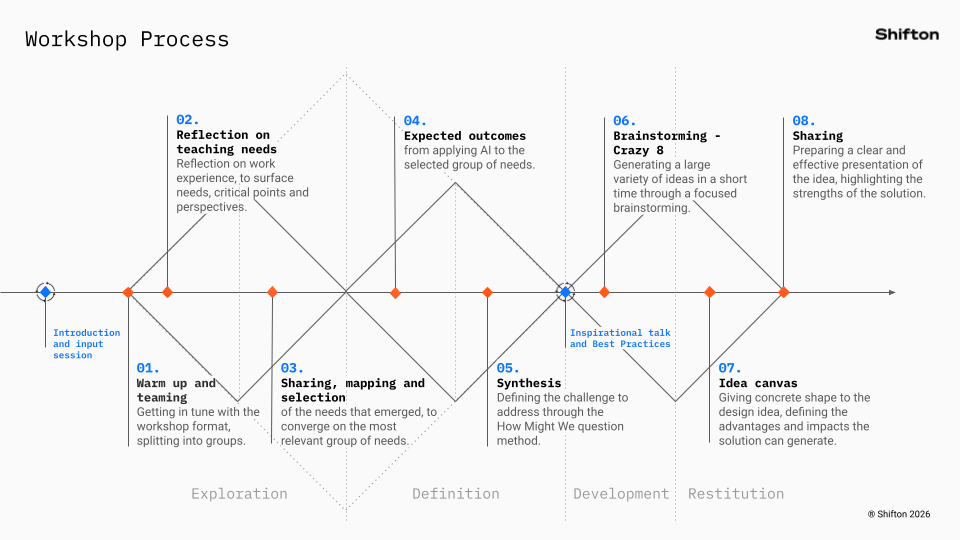
We accompanied professors in designing concrete actions to integrate AI into teaching, starting from reflection on their own needs. The methodological framework integrated design thinking activities and labs, with the aim of building on experiences already present in the room and opening up to new possibilities.
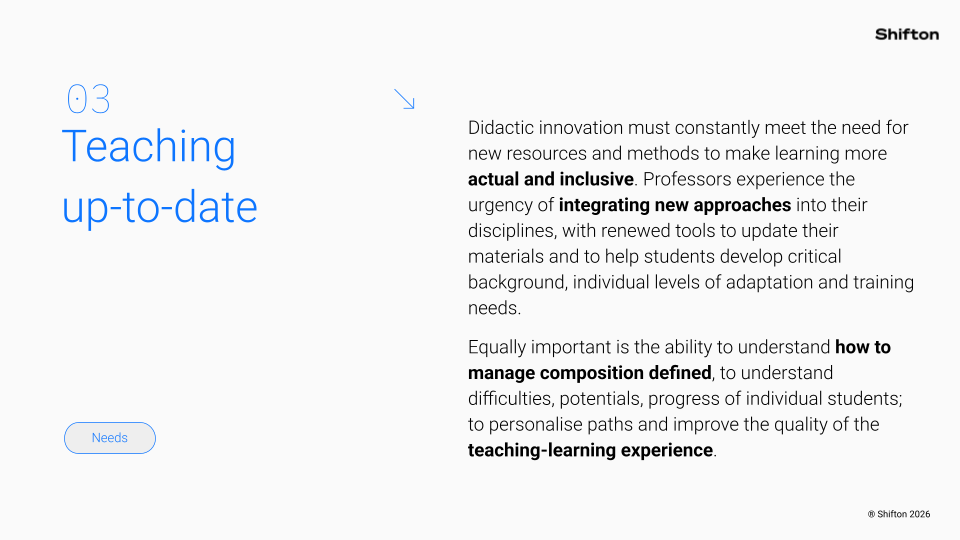
The workshop was structured over three days, built around a journey that guided participants from personal reflection to the design of collective practices. At each stage, the activities highlighted the most vivid tensions in daily work: difficulty keeping students’ attention in class, the time taken away from teaching activities by administrative tasks, the desire to train students with critical thinking skills and not as passive users of tools. Tensions that existed before AI, but that this has made more urgent and tangible.
Naming these needs collectively was the first step to transforming them into design material. Through a mapping and selection process, each group identified the priorities to focus on and formulated a How Might We question — a tool that shifts attention from the problem to the possibility, from the challenge to the creative invitation. This shift allowed the register of the conversation to change, moving from a one-of-difficulty to an open-question mindset.
The development phase opened with an inspirational moment: professors shared practices they already use, offering concrete starting points that everyone can build on. A rapid brainstorming produced as many ideas as possible, allowing each participant to become material for others. From this, each group selected and refined one practice, working on objectives, methods, implementation modalities and impacts already tested in teaching.
At the end of the workshop, each group presented its work in a brief presentation — an exercise that reinforced the variety of perspectives present in the room and transformed the final moment into a further collective sharing space.
The work produced a set of concrete practices, organised around four directions: promoting student participation, automating to reclaim time, simulating real scenarios, personalising teaching. Looking at these four clusters, a significant piece of data emerges: professors focused on the aspects that today generate the most frustration, those most difficult to manage or to carry out as one would like. It is precisely in these areas that the contribution of AI is imagined. From here, the need to rethink the professor’s role: from holder of knowledge, a figure with strong control over content, to a facilitator of learning, capable of designing engaging formative experiences and enabling students to use tools with a critical spirit.
Confidential