
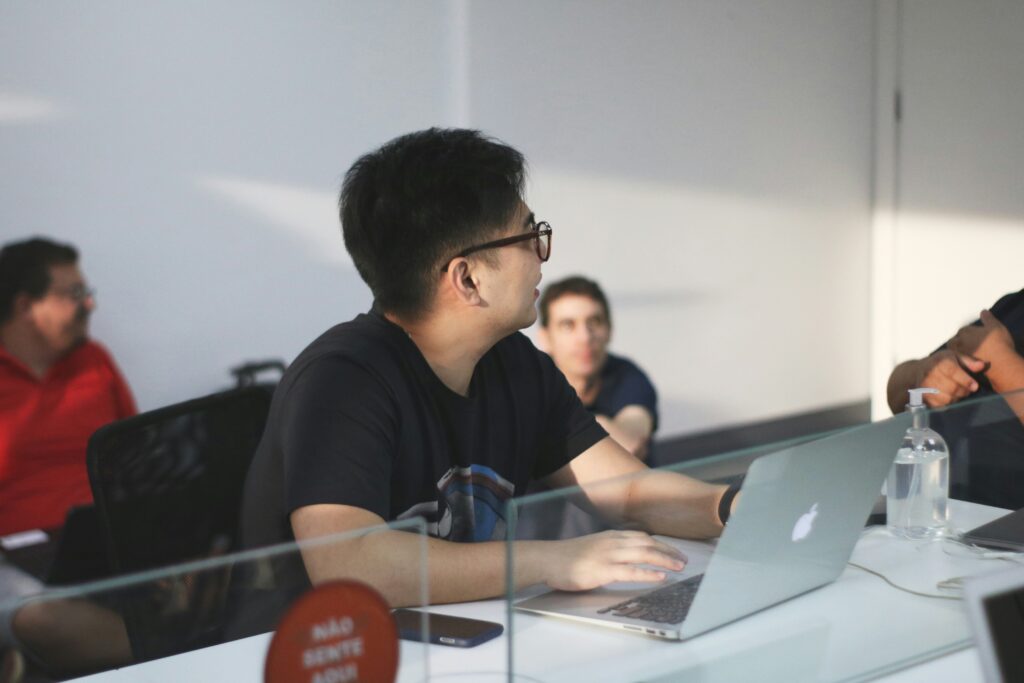


Over the course of a three-day hackathon, students from a prestigious Italian university envisioned new teaching models capable of making public higher education more competitive while also more accessible and meaningful in the age of emerging technologies.

How can we co-design new educational models for universities that meaningfully integrate emerging technologies and inclusive practices, making the learning experience more competitive, accessible, and future-oriented?
We conceived the hackathon as a co-design process grounded in two operational premises.
First, listening and field research, enabling participants—undergraduate, graduate, and doctoral students—to transform intuitions and lived experiences into solid insights and, subsequently, into design opportunities.
Second, technology was treated not as an end in itself, but as an enabler of learning and university relationships, with quality assessed according to solutions that are innovative, inclusive, scalable, sustainable, and future-oriented.
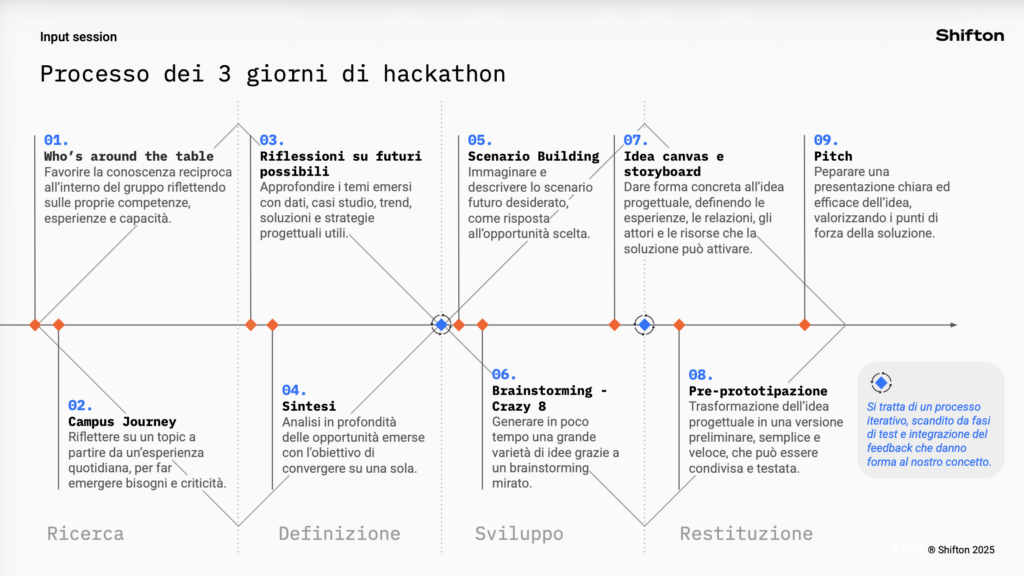
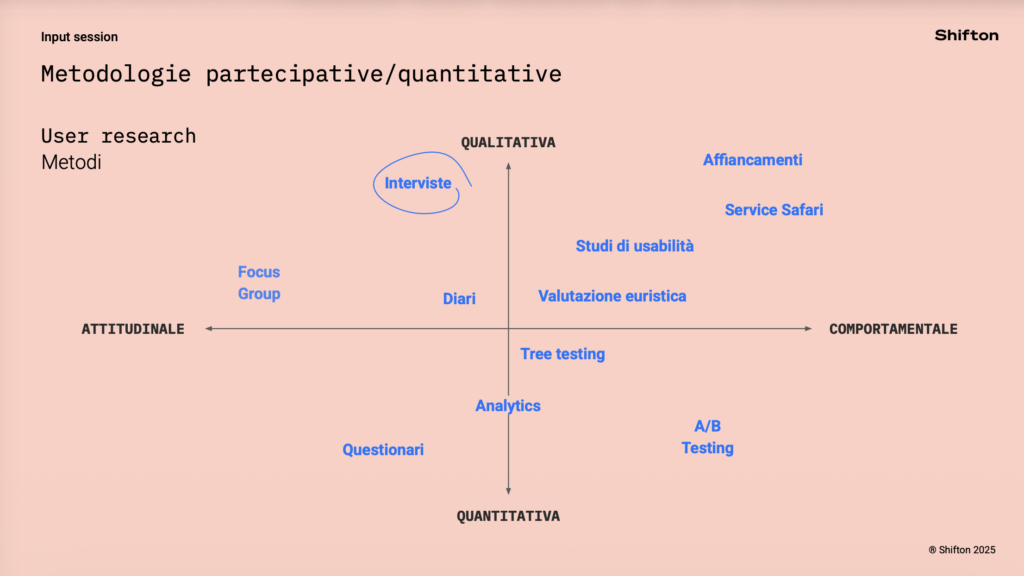
The programme was designed to guide student teams from an initial understanding of the context to the development of proposals that could be clearly presented and critically discussed. Following an initial phase of alignment and team building, the qualitative research combined on-campus exploration with desk research, supported by interviews guided by a script inspired by Appreciative Inquiry—an approach that, rather than focusing solely on problems, investigates what works, people’s aspirations, and the conditions that enable positive change.
To broaden perspectives beyond the “here and now” without losing touch with reality, we adopted the Three Horizons framework—a lens that helps interpret the present, imagine trajectories of change in the medium term, and construct more radical scenarios in the long term, making innovation progressively designable.
The insights collected were then synthesised and translated into “How might we…?” challenges, leading to the identification of three opportunity areas: digital literacy, learning experiences, and the student–faculty relationship.
This opened a more structured phase of exploration and convergence. First, teams worked on possible futures and scenario building to generate credible and desirable alternatives; this was followed by rapid ideation sessions—including generative exercises such as Crazy 8—to multiply solutions, put them under tension, and select the most promising directions.
The selected ideas were gradually developed into more concrete design proposals. They were translated into an initial architecture through canvases and storyboards, clarifying target users, value propositions, service components, and conditions for adoption. They were then tested at low fidelity through a pre-prototyping phase, aimed at assessing coherence, feasibility, and expected impact prior to formalisation.
The final stage of the process focused on building the final pitch, making the proposals communicable and comparable. Throughout the entire journey, facilitated check-ins led by Shifton and supported by faculty members from the university’s technical-scientific committee helped teams move forward, improving the quality of decision-making and keeping the work oriented toward innovative, inclusive, and scalable solutions.
Le idee sviluppate durante l’hackathon rappresentano una prima risposta progettuale alla sfida e, soprattutto, una base comune su cui continuare a lavorare: indicano direzioni concrete per un apprendimento più esperienziale, più relazionale, più equo e più personalizzato.
I risultati sono stati presentati e discussi all’interno di un gruppo di lavoro dedicato all’innovazione didattica, contribuendo alla riflessione su nuovi modelli formativi e sugli scenari dell’università del futuro.
Confidential