

A leading Italian university commissioned us to design and facilitate a hackathon for 600 students, focused on the critical use of artificial intelligence in higher education.

How do you engage 600 students in a creative process that goes beyond discussing AI as a trend, encouraging them instead to question when to use it, why and what impact it has on their study habits?
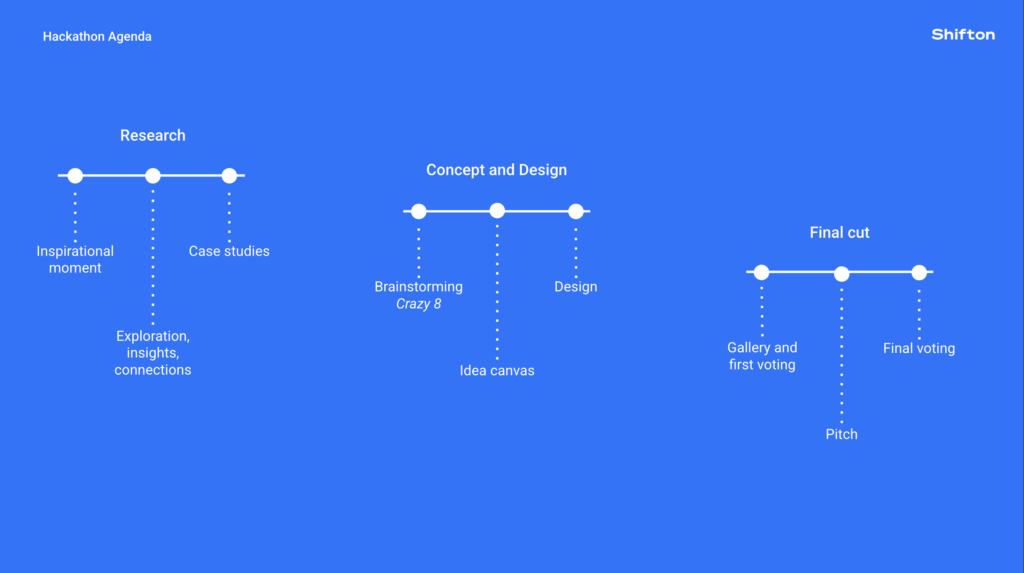
We designed a three-act hackathon: an exploration and research phase, a production phase focused on creating digital artifacts to spark meaningful dialogue about mindful AI usage in university studies, and a final pitch competition with public voting.
Four ethical principles guided the entire day:
1. AI Transparency
2. Centrality of Authorship
3. Value of Non-Digital Processes
4. Alignment Between Theme and Methodology
The morning kicked off with an inspirational keynote by an AI expert, designed to spark curiosity and equip teams with a shared vocabulary for the day.
Immediately after, participants split into diverse, multidisciplinary teams to launch a three-tiered research phase. On phase 1, teams received “mission cards” to complete through guided exploration, such as expert phone calls, direct observation or web research. On phase 2, each participant extracted three key insights from their findings, Finally, on phase 3, teams brought their insights together, clustering the results into key themes and patterns.
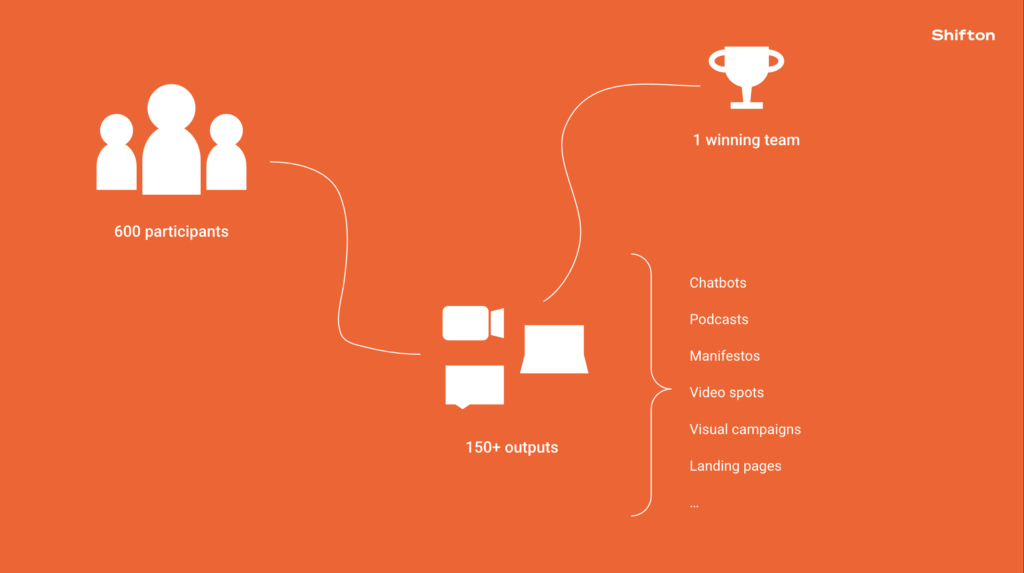
Following the research phase, we hosted a showcase featuring various communication artifacts—ranging from landing pages and comic strips to value manifestos, AI-generated podcasts, interactive installations, and visual campaigns. The goal was to broaden their horizon of possibilities without constraining their creative choices.
The ideation phase began with a series of exercises designed for rapid, high-volume idea generation. The strongest concepts were first developed individually and then shared within each team, converging into a system of at least two cohesive artifacts aligned in tone, message or perspective.
The afternoon was dedicated entirely to bringing the artifacts to life. After four hours of uninterrupted work, each group set up an exhibition of their projects. Participants toured the showcase and voted for the top six projects. The six finalists presented their work in a grand finale before a panel of students, professors, experts and facilitators, who crowned the final winner.
Documenting the creative process—including choices made, tools used, and the specific role assigned to AI at every stage—was an essential requirement of the final submission.
The event yielded over 150 communication artifacts powered by the collective intelligence of more than 600 participants. The winning team will now have the opportunity to implement their project directly within the university. This provides the institution with student-designed communication systems to help peers adopt a reflective, intentional, and critical approach to artificial intelligence.
The next challenge is seeing how this mindset—forged in the dynamic environment of a hackathon—takes root in everyday study habits and evolves into a lasting culture across the academic community.
Confidential