


A new imaginary for the iconic villa in Verona, where nature, society and architecture engage in a dialogue, establishing human connections as the core infrastructure for well-being.

How can we transform Villa Francescatti—a historic Veronese noble residence—into a space capable of fostering new relationships and embracing vulnerability, while preserving the building’s historical memory and balancing community participation with economic sustainability?
The strategy was rooted in deep listening and shared imagination to identify the leverage points needed to rethink Villa Francescatti as a hub where social mission and economic sustainability coexist. We wove together diverse voices and aspirations to build a shared identity and vision—one where care, innovation and immersion in nature come together as the core elements of an open, interdependent community space.
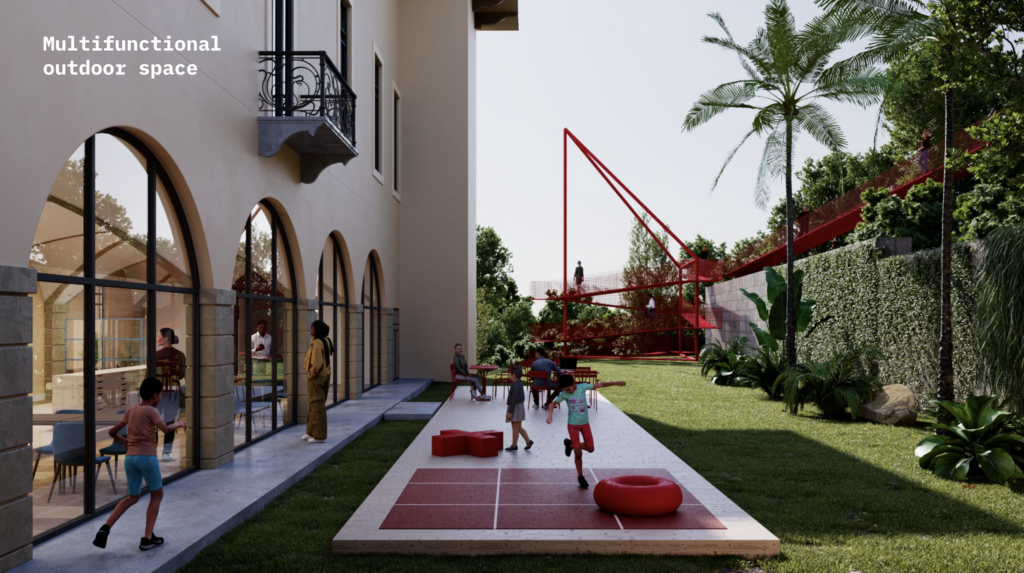
Overlooking the hills that face Verona’s historic center, Villa Francescatti is an elegant 16th-century noble residence of extraordinary prestige. While it has preserved its symbolic value throughout the decades, today it calls for a reimagining as a hybrid environment capable of generating well-being. The narrative starting point was the berceau (arbor), a structure that historically defined shaded resting areas among the villa’s climbing plants. This metaphor, which can also be traced within the decorations of the grand internal staircase, became the common thread linking monumental memory to a future of lightness and hospitality.
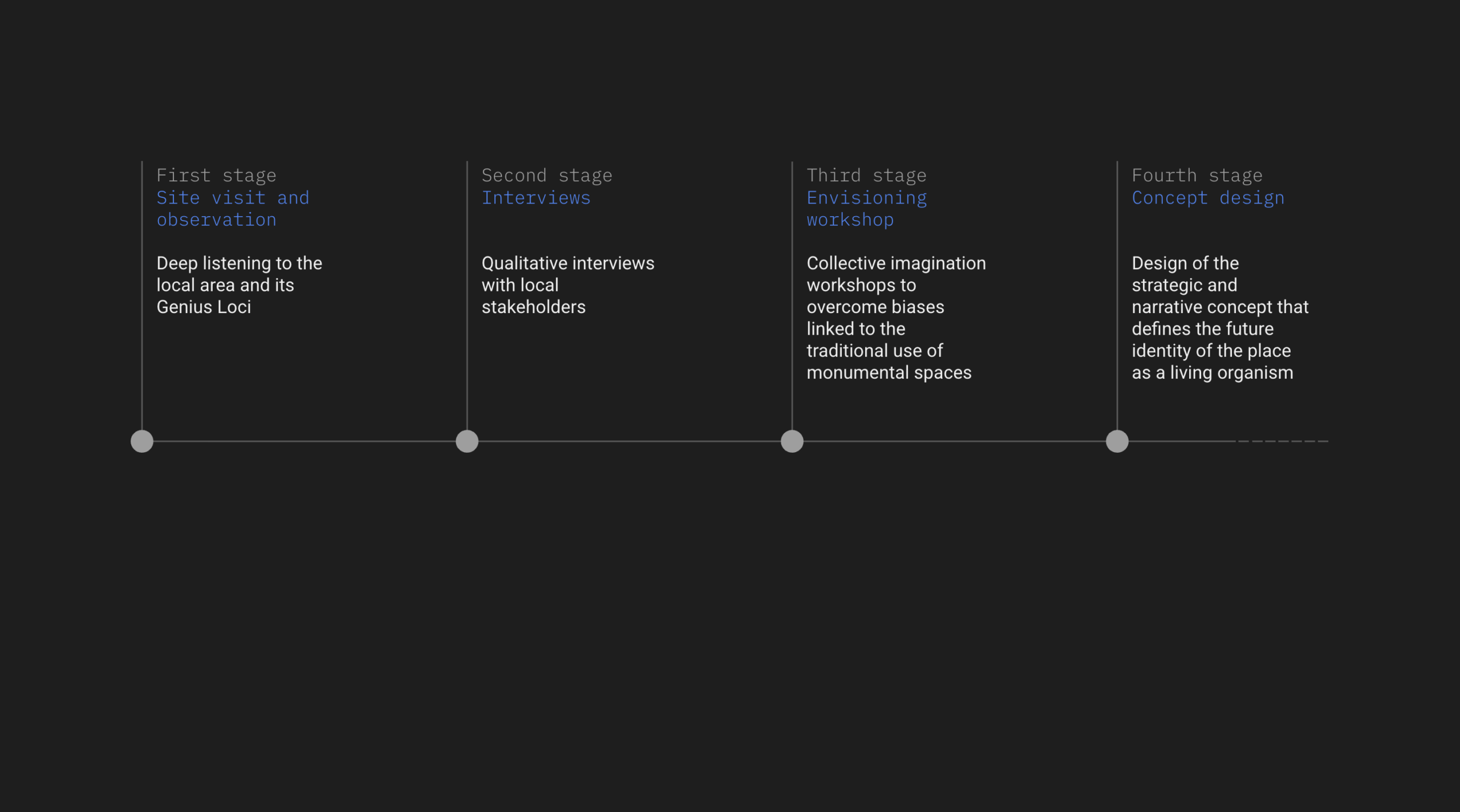
The first step in imagining the future of Villa Francescatti consisted of deep listening to the local territory and its Genius Loci. Through exploratory site visits, we observed how the spaces could re-engage in a dialogue with the city, complementing this analysis with qualitative interviews with local stakeholders. This dialogue brought to light dreams, visions and desires, as well as existing tensions, turning the critical friction points of the Veronese context into concrete design opportunities.
The heart of the process was the envisioning workshop—a moment of collective imagination where participants worked to overcome the biases tied to the traditional use of monumental spaces. During this co-design phase, the Villa was conceptually deconstructed and rebuilt, allowing new functions, such as a social bistro or a decentralized school, to emerge. Rather than mere services, these functions were framed as rituals of conviviality. The insights generated by this collective intelligence culminated in a strategic and narrative concept, mapping out the future identity of the place as a living organism.
The concept, resulting from a participatory process led by Shifton that involved over 70 people including strategic stakeholders, third-sector organizations, Diocesi di Verona and local citizens, is structured around four interconnected dimensions:
Welcome | A vision of hospitality as a practice of peace, featuring spaces for social dining and temporary residencies.
Educate | The idea of an open, permeable school dedicated to experiential learning and active citizenship.
Innovate | A hub for civic experimentation, designed to incubate social and environmental impact.
Inspire | A garden of cultural biodiversity, where art and nature become shared languages for coexistence.
Piazza Francescatti shifts the perception of the Villa from a static monument to a dynamic ecosystem, where diversity is embraced as a driver for innovation. The definition of the strategic concept does not mark the end of a journey, but the very first step toward ensuring the area’s social and economic viability.
The future envisioned by citizens and stakeholders for Villa Francescatti is one of a physical and metaphorical bridge—connecting history with innovation and nature with community—rendering hospitality and care everyday practices for the whole city of Verona.
Fondazione Cassa di Risparmio di Verona
Diocesi di Verona
diverserighestudio Architects
Area Proxima
Marzio Mirabella
Giancarlo Galante
Provare a immaginare come si può trasformare una dimora storica in un esempio desiderabile di futuro. Questa la sfida alla base di un percorso di ricerca e co-progettazione che in questi mesi ha visto collaborare fianco a fianco Diocesi di Verona, Fondazione Cariverona e Shifton — studio di design per l’innovazione sociale, nel ruolo di consulente strategico del progetto.
Cinquanta persone, rappresentanti di tutta la cittadinanza in base all’età, alla professione, al ruolo sociale, hanno vissuto un momento di immaginazione collettiva, facendo emergere alcune possibili nuove funzioni.
A Verona, Diocesi, Shifton e Fondazione Cariverona hanno avviato un percorso di ricerca e co-progettazione per trasformare Villa Francescatti, dimora storica sulle colline della città, in un laboratorio aperto di comunità, educazione, innovazione e cura del territorio.
Nuova vita per Villa Francescatti a Veronetta: Diocesi di Verona, Fondazione Cariverona e Shifton presentano un percorso di co-progettazione per trasformare la Villa in un ecosistema dedicato ad accoglienza, educazione e innovazione.
Diocesi di Verona e Fondazione Cariverona hanno avviato il percorso di co-progettazione “Villa Francescatti 2035” per immaginare la riapertura dello storico complesso di Veronetta.