

Born out of the experience of the “Curiel” pedagogical research and experimentation lab in the municipality of Vimodrone, LAPS now presents itself as a living ecosystem—an educational and relational space where children, families, educators, and the local community come together to foster shared well-being.
An educational experience already in motion, yet seeking recognition.
How can we co-construct the visual and narrative identity of LaFucina’s educational approach—a social cooperative based in Milan—and transform it into a recognizable model capable of cultivating relationships within the community?
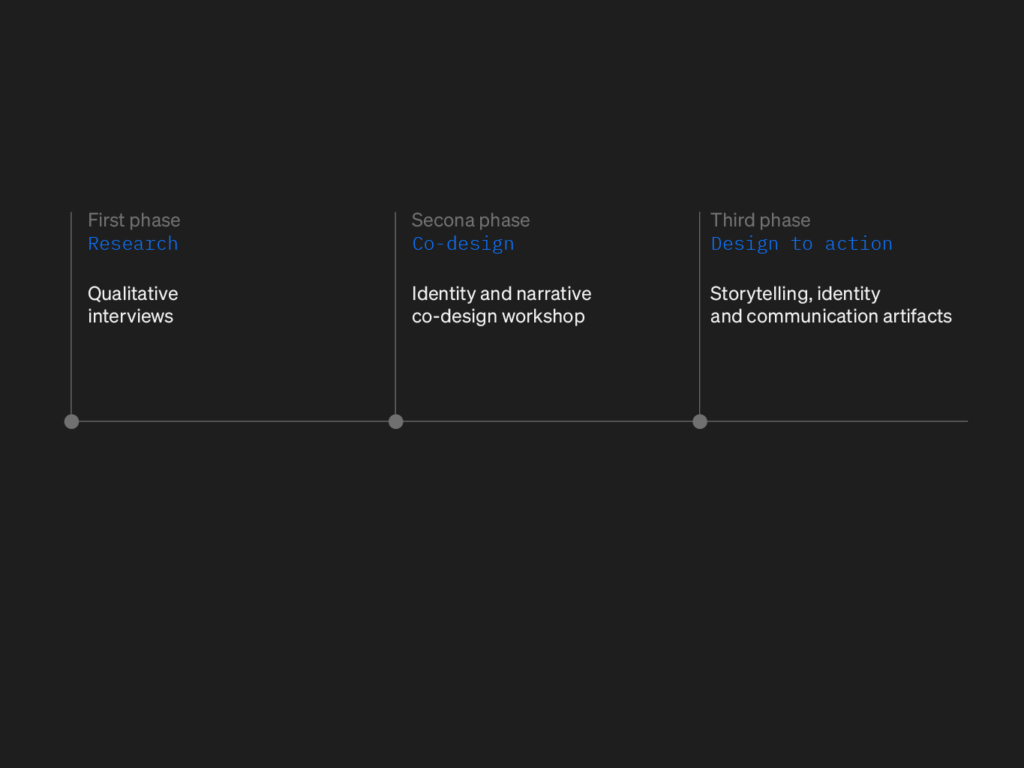
To transform the experience of Curiel—the pedagogical research and experimentation lab of the municipality of Vimodrone—into a recognizable and replicable project, we envisioned a process rooted in the lived experiences of those who inhabit this space daily. Relationships, everyday gestures, and both formal and informal educational practices became the material for collective reflection, bringing meaning and vision to the forefront.
Through moments of dialogue, listening, and co-design, we supported LaFucina, the social cooperative managing the Curiel lab since 2019, in defining a storytelling framework and visual identity that would remain faithful to the lived experience while also projecting the lab’s future direction.
A mosaic of voices, stories, and perspectives initiated the process: families, educators, cooperative members, partners, and representatives from the Municipality of Vimodrone all contributed—through qualitative interviews—to capturing the full complexity of Curiel. Simultaneously, a site visit to the Curiel Center allowed us to map the project’s evolutionary trajectory and place it within a specific social context and the broader framework of local educational practices.
The sensemaking process highlighted a reality perceived as generative and informal, built on authentic, everyday relationships—yet still in search of a narrative capable of fully expressing its potential.
From these foundations, we facilitated a storytelling co-design workshop structured around two key phases: the exploration of narrative archetypes to uncover the deeper elements of LaFucina’s educational vision, and the collaborative writing of a manifesto to synthesize and share the project’s essence internally and externally.
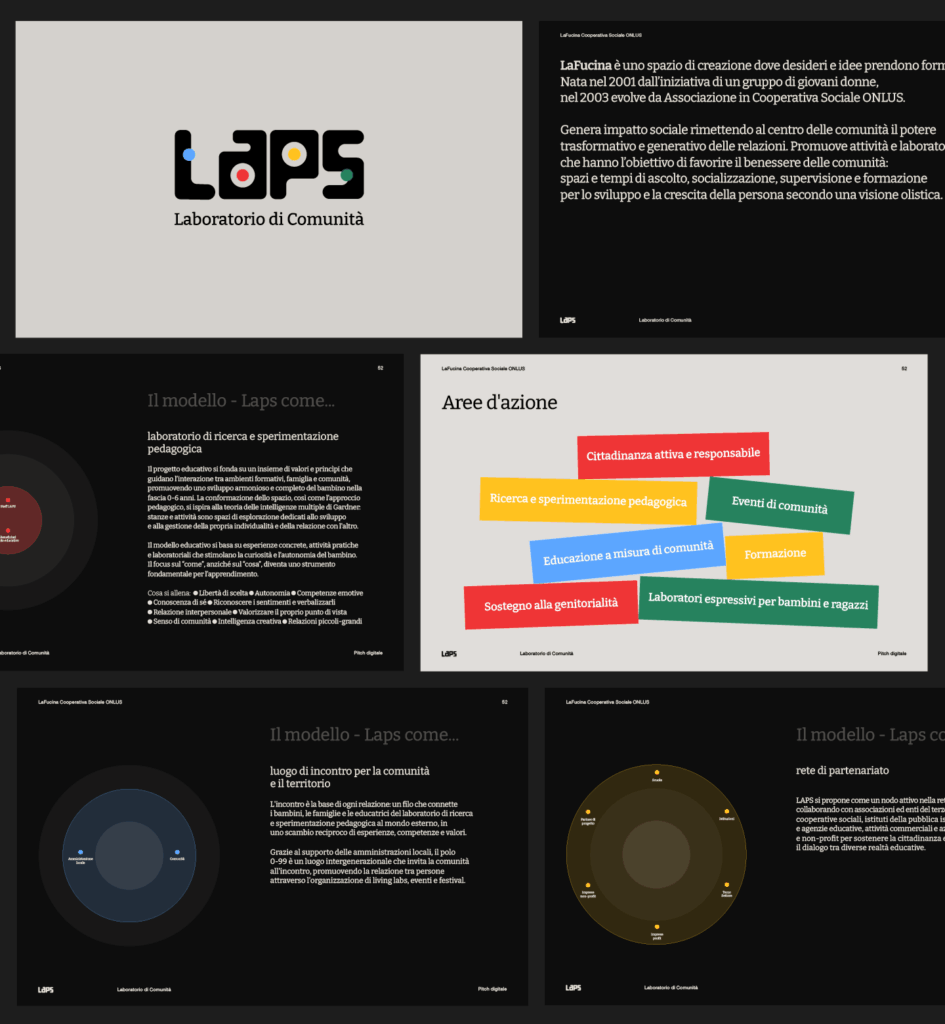
LAPS’ identity takes shape around a structure of overlapping and expanding concentric circles—hence the name—symbolizing the plurality and proximity of a community growing together, open to diversity and beauty.
LAPS emerges as a Community Laboratory: a cultural hub for gathering and educational experimentation, where early childhood and pedagogical research find fertile ground to grow and innovate.
Its framework is supported by a network of alliances among diverse actors, exchanging resources, spaces, and projects to build a model of cooperation between the public, private, and third sectors.
At the heart of LAPS lies the pedagogical research and experimentation lab: an innovative 0–6 years space that enriches the community’s educational ecosystem. Surrounding this core are varying degrees of relational proximity and involvement:
those who engage daily—children, families, educators; those who closely support it—the administration, project partners, the local community; and those more distantly connected yet still engaged—schools, cultural institutions, third-sector organizations, and even private enterprises.
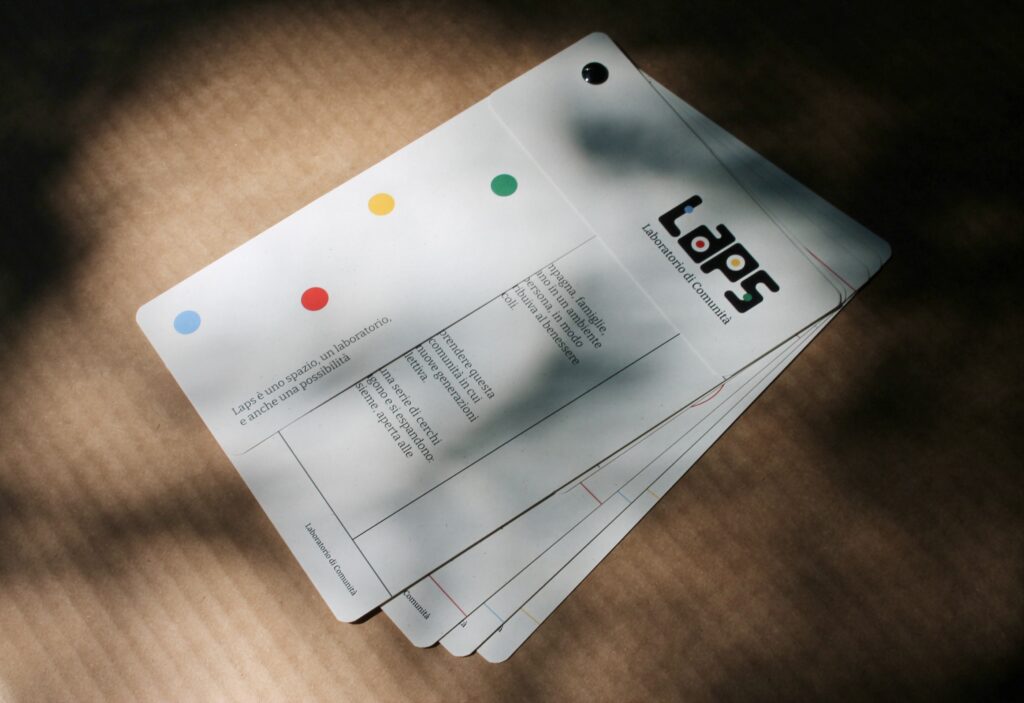
Two narrative tools complete LAPS’ storytelling: the first is a fan deck, a visual and narrative instrument created to convey the identity and aims of the community lab in a direct and engaging way; the second is a project pitch, which provides a clear and concise overview of the initiative. Together, these tools offer LAPS the means to present itself effectively, spark interest, and support the development of new strategic partnerships.
The development of LAPS’ narrative and visual identity enabled LaFucina to give clear form to a project that already existed in practice but struggled to be communicated and shared externally. This narrative and symbolic articulation—from the name to the concentric circle structure, from the value framework to the visual materials—brought coherence and depth to a vision, offering the cooperative tangible tools to tell its story, forge new alliances, and assert a stronger position in dialogues with institutions, families, and partners.
LaFucina Cooperativa Sociale ONLUS