

The advent of the pandemic has put the luxury fashion sector to the test, profoundly redefining the retail experience. Shifton was commissioned to design a training course for the employees of a well-known international brand to strengthen the sense of belonging and purpose of the sales teams.

How can we encourage the involvement and motivation of sales teams starting from a process of evolution and elevation of the brand’s client-experience in line with the needs dictated by the post-pandemic context?
How can we trigger a process of cultural transformation through a human-centered training program that leverages the needs and collective intelligence of company employees?
To respond to such a complex challenge, we started from the analysis and recontextualization of the values, narrative, and client-experience of the brand in a human-centric and post-pandemic key, actively involving various company stakeholders.
We worked on a global scale, initiating a co-design process that had the brand’s Training Managers as its main recipients, who were then tasked with training the employees of the individual stores.
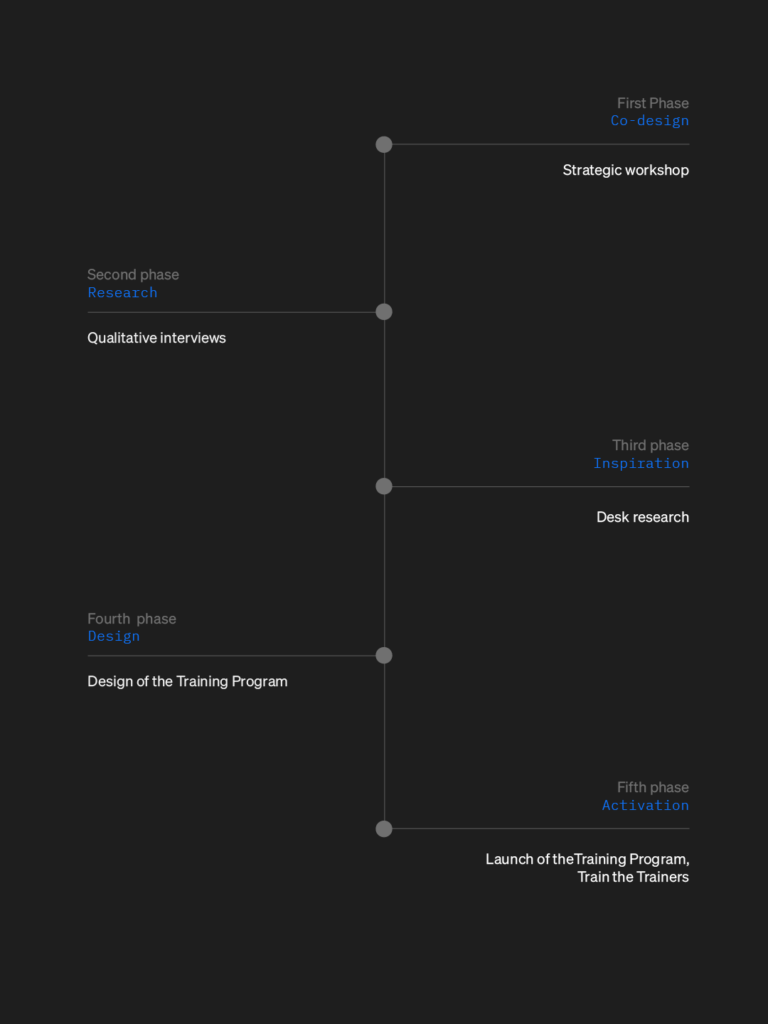
Through an initial strategic workshop, together with some key figures and company managers, we worked on redefining the values and the most significant moments of the client-experience, building a future scenario capable of guiding its evolution. During the next phase, we conducted a series of one-to-one interviews with the store managers of the individual sales outlets to map and understand the needs, strengths, and weaknesses related to the current in-store experience, favoring the point of view of the sales teams. A desk research allowed us to map cases of inspiration and best practices in the world of training.
Based on what emerged, we designed a training program and a toolkit – consisting of tools, best practices, and guidelines – aimed at the company’s Training Managers, focusing on three main themes:
• Evolution of the client-experience, evolution in a human-centric and post-pandemic key of the values and key moments of the experience.
• Sharing culture: tools and rituals to promote collaboration and sharing processes on a different scale among store employees.
• Cultural awareness: tools to facilitate the acquisition of cultural knowledge related to the local context of each store.
These first three training modules were followed by two more, aimed at the acquisition and consolidation of hard and soft skills by the training managers and the construction of a community of practice capable of facilitating the exchange of knowledge and skills at a global level:
• New Ways of Working: tools and practices for collaborative work and effective planning.
• Visual Thinking: tools and practices of visual thinking and graphic facilitation to promote the effective transmission of content and ideas (module held in partnership with Housatonic).
The training program we designed highlighted the importance of co-design and participation as tools for creating and implementing effective human-centered experiences over time and adaptable to different local contexts. The use of co-design tools and methods during the training allowed us to establish an open dialogue and a continuous feedback mechanism with the Training Managers, placing their needs at the center of in-store staff training. The process allowed the Training Managers to familiarize themselves with innovative interaction tools and methods that leverage the knowledge, needs, and specificities of each sales team.
Confidential