


In the transition to a new business model, the relationships between a company's employees, partners and customers must also adapt to the change taking place. Cisco commissioned Shifton to facilitate the ongoing transformation phase by co-designing new rituals to be introduced in the life of the company.

How to trigger a cultural transformation that leads to a greater awareness of the new way of interacting between Cisco, customers and partners?
A company is made up of the people who work in it and the relationships they build with each other. To facilitate and enhance human relationships in a phase of rapid change, we have designed a co-design of new rituals to be introduced in Cisco’s complex work ecosystem, which includes employees, customers and partners.
Well-designed rituals are out-of-the-ordinary, repeated and repeatable experiences, capable of triggering new ways of interaction between people. A ritual generates cohesion, creates shared horizons of meaning and facilitates adaptation to structural changes.
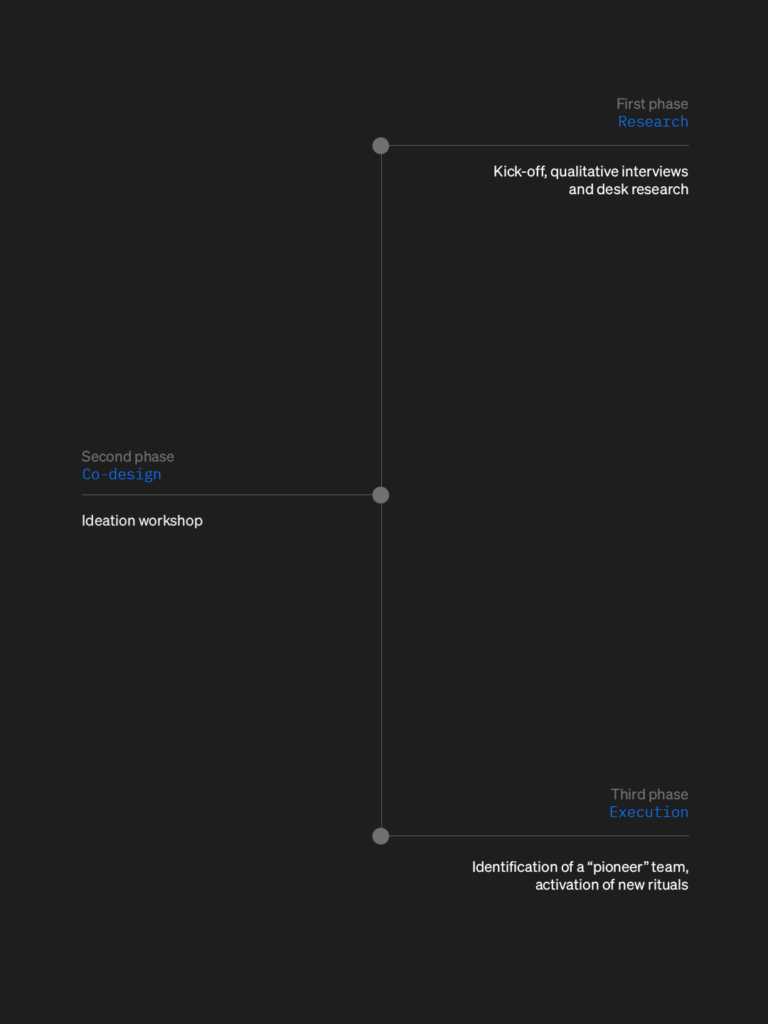
Through a series of exploratory interviews with Cisco insiders, customers and partners, we mapped needs and aspirations. Using the Appreciative Inquiry technique, we collected the success stories that have been realised in the Cisco ecosystem, in order to bring out the resources that are already available for the ongoing transformation process.
In the desk research phase we studied national and international cases, in order to understand what led to the success of similar paths.
In the ideation workshop, we worked together with the Cisco team, partners and customers to identify four ritual ideas that could facilitate the change process. This made it possible to valorise the talents directly involved in the ongoing change process, creating a sharing space in which the value brought by each team was recognised and celebrated.
From the co-design, ideas emerged that were able to inspire the transformation of the entire ecosystem of relationships according to certain guiding principles: client-centred approach, creation of a sense of community for the partners, and enhancement of Cisco as Thought Leader.
Finally, the realisation of the rituals was entrusted to an internal Cisco pioneer team: ambassadors and facilitators of the cultural transformation underway, who from the inside can inspire change.
The co-design process made it possible not only to identify the resources already present in Cisco, but also to recognise and defuse certain elements potentially hindering change.
The rituals designed reflect the client-centred approach at the heart of Cisco’s transformation process and clearly convey, externally as well as internally, a vision that is future-oriented, open to innovation, and able to adapt to the global transformation of the economic system.
Thanks to the rituals designed, Cisco emerges as a “thought leader” capable of inspiring the evolution of its relational ecosystem and becoming a model of cultural change. Even beyond corporate boundaries.
Cisco System